Growing Sierra Leone's Most Important Staple Crop
Rice is the foundation of the Sierra Leonean diet. It is eaten at nearly every meal across the country, making it far more than just a crop — it is a matter of national food security. Yet despite Sierra Leone's fertile soils and favourable growing conditions, the country continues to import hundreds of thousands of tonnes of rice each year. Closing this gap through domestic production is one of the most important agricultural challenges the nation faces.
Kabba Agricultural Enterprise operates a dedicated rice farming programme on 17 acres of farmland in Mamuntha Mayosoh Village, Tonkolili District. Using the high-yield Rock 34 Hybrid variety, our rice programme is designed to maximise production while creating meaningful employment for local communities.
Why Rice Farming Matters in Sierra Leone
Sierra Leone's population relies on rice as its primary source of calories. The country consumes approximately 600,000 to 700,000 metric tonnes of milled rice annually, but domestic production has historically met only a fraction of that demand. The resulting import bill drains foreign exchange reserves, exposes consumers to volatile international prices, and leaves rural communities particularly vulnerable during the annual hunger season between planting and harvest.
Every kilogram of rice grown domestically is a kilogram that does not need to be imported. Local rice farming directly reduces import dependency, keeps money circulating within Sierra Leone's economy, and provides reliable food access for communities that might otherwise face shortages. This is why rice farming is not simply an agricultural activity — it is a pillar of national food security.
The Rock 34 Hybrid Variety
Not all rice varieties perform equally in Sierra Leone's growing conditions. At Kabba Agricultural Enterprise, we selected the Rock 34 Hybrid for its combination of high yield potential, disease resistance, and adaptability to the soils and rainfall patterns found in Tonkolili District.
This improved variety produces more grain per acre than many traditional varieties, which means our 17-acre programme can contribute meaningfully to local supply without requiring the vast land areas associated with extensive rice cultivation. The Rock 34 Hybrid matures within a single growing season, allowing for timely planting during the June–July window and reliable harvesting by November.
Our Rice Farming Methods
Our farming process for rice follows a carefully planned seasonal cycle that combines mechanised efficiency with hands-on community labour:
Land Preparation (April – May) — Tractor-assisted clearing and ploughing prepares the 17-acre plot for planting. Mechanised preparation ensures even soil conditions and removes competing vegetation.
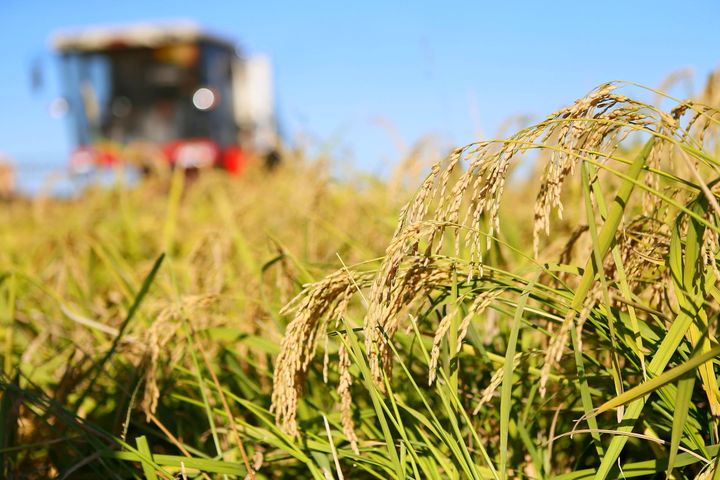
Seed Selection and Planting (June – July) — We use 13 bags of Rock 34 Hybrid seed, broadcast across the prepared land during the early rainy season. Broadcasting is the most efficient planting method for rice at this scale.
Crop Management (August – September) — Manual weeding in August maintains healthy growing conditions. In September, 42 bags of fertiliser are applied to support the crop through its critical growth phase.
Harvesting (November) — Harvesting is carried out by manual labour from the local community, ensuring precision and creating significant seasonal employment.
Post-Harvest Processing (December) — The harvested rice is bagged and prepared for transport to local and regional markets.
Economic Contribution
Rice farming at Kabba Agricultural Enterprise generates economic value at every stage of the production cycle. From the tractor operators who prepare the land to the community members who plant, weed, and harvest, each phase creates paid employment for people in Tonkolili District.
The economic benefits extend beyond direct farm employment. Local rice production supports regional traders, transporters, and market vendors. It reduces the outflow of foreign currency spent on imports and strengthens the domestic food supply chain. As the farming sector grows, its multiplier effects ripple through rural and urban economies alike.
Alignment with National Goals
The Sierra Leone government has identified rice self-sufficiency as a national priority. Through the Ministry of Agriculture and Food Security, programmes including the Rice Self-Sufficiency Strategy aim to increase domestic production through improved seed varieties, mechanisation support, and farmer training. Government agriculture initiatives create the enabling environment within which private enterprises like ours operate.
Our rice programme is led with direct oversight from the District Agricultural Officer for Tonkolili, ensuring alignment with national food security objectives and access to district-level agricultural support services.
Sustainability and Soil Health
Rice farming at Kabba Agricultural Enterprise is part of a broader three-crop system that includes groundnut and pigeon pea. This crop diversity is not accidental — it is a deliberate strategy for long-term soil health. Pigeon pea, as a nitrogen-fixing legume, restores soil fertility naturally, improving conditions for subsequent rice rotations and reducing dependence on synthetic fertilisers.
By combining productivity with sustainability, our approach ensures that the farmland remains productive for future growing seasons — not just the current one.